
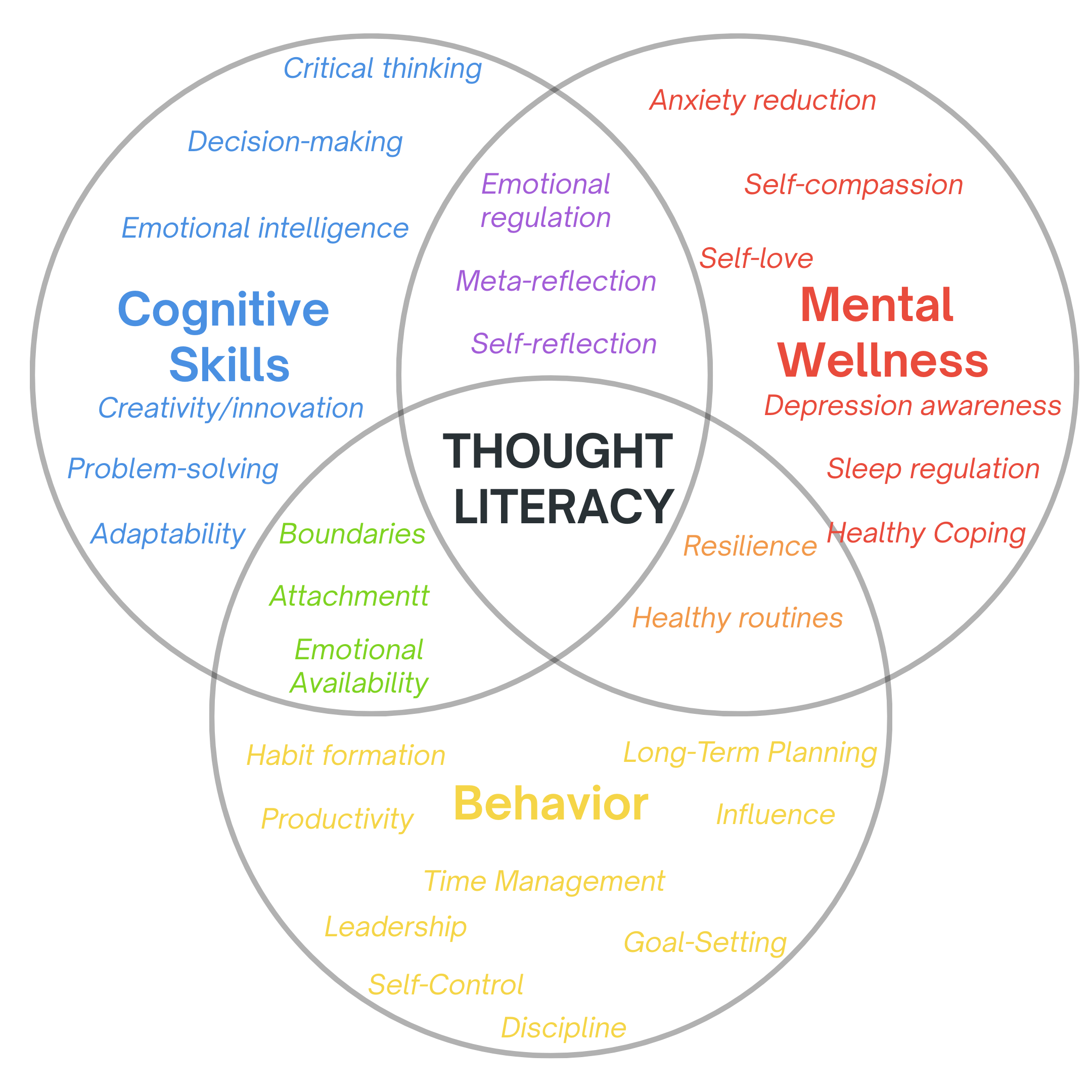

When I set out to outline the benefits of thought literacy, it was tough not to sound like an infomercial selling something shady, “thoughts change everything!” So I started to list out individual benefits like self-awareness and better mental health, but no matter how many times I edited the list (and I edited it A LOT) I didn’t think I was doing thought literacy justice.
That’s when I realized that thought literacy isn’t just a skill, it’s a meta-skill, meaning it applies to every area of life where thinking is involved. And people who are thought literate aren’t just going to be aware of and manage their thoughts, they’re going to have an easier time building any skill or habit that’s cognitively based or requires thinking.
So now I can confidently state that thought literacy literally changes everything in every area of your life, and I’m showing my work below!
First, What is Thought Literacy
Thought literacy is the awareness and management of your thoughts. Someone who is thought literate uses their thoughts as a resource. So instead of thinking, “I can’t do this,” they would think, “I’m thinking I can’t do this, where is this thought coming from?” And instead of trying to force positivity, going from “I can’t do this,” to “I’m going to do this amazingly,” they would prioritize balance, “This is something new, but I’ve done hard things before and when I try, I can do this too.”
This general skill in working with your thoughts and knowing how your mind works is something you can then leverage into every other cognitive-based skill or behavior you’re aiming for. What makes this powerful is simple cause and effect. Thoughts shape emotions. Emotions influence behavior. Repeated behaviors build skills and habits. When you improve the quality of your thoughts at the start of that chain, everything downstream improves.
Once you understand that thoughts drive emotions and behavior, it becomes easier to see why so many skills are cognitive at their core.
Cognitive-Based Skills
Most people don’t realize it, but most skills are largely cognitive, meaning they are influenced by your thoughts. Critical thinking, self-awareness, decision-making, adaptability, leadership, and even resilience, self-love, secure attachment, and emotional availability can all be learned by focusing on thoughts.
Here are the top 25 cognitive-based skills most relevant today, based on workforce and social trends:
Top 25 Cognitive-Based Skills
- Critical thinking – noticing assumptions, evaluating information, making reasoned judgments.
- Decision-making – weighing options, anticipating outcomes, choosing intentionally.
- Self-awareness – understanding your thoughts, emotions, and patterns.
- Adaptability – changing your approach when circumstances or ideas shift.
- Emotional regulation – managing reactions and staying composed.
- Resilience – recovering from setbacks without being stuck in negative thinking.
- Self-confidence – building belief in your abilities through realistic thought patterns.
- Empathy – understanding others by recognizing your own thought biases.
- Emotional availability – being present with others, aware of your internal narratives.
- Leadership – noticing biases, managing your thinking, and responding intentionally.
- Problem-solving – breaking challenges into manageable steps using clear thought.
- Focus and concentration – directing attention and avoiding distracting thoughts.
- Time management – planning, prioritizing, and resisting impulsive decisions.
- Impulse control – noticing urges before acting and choosing deliberate responses.
- Self-discipline – following through on commitments through consistent thought management.
- Goal setting – forming clear, achievable objectives based on realistic thinking.
- Planning and organization – structuring tasks and resources effectively.
- Learning agility – recognizing gaps in knowledge and adjusting thoughts to learn.
- Stress management – using thought awareness to reduce anxiety and pressure.
- Conflict resolution – seeing multiple perspectives and adjusting thinking for solutions.
- Negotiation skills – preparing, anticipating reactions, and responding strategically.
- Creativity – generating ideas by exploring different mental approaches.
- Mindful communication – noticing your thoughts before speaking or acting.
- Self-reflection – reviewing decisions, patterns, and outcomes for growth.
- Habit formation – connecting thoughts to repeated actions and long-term routines.
Example of a Cognitive Skill Build
I continually build cognitive skills using thought literacy. For instance, when I realized I had a disorganized attachment style, I focused on the thought patterns of someone with a secure attachment style and learned to practice those patterns myself.
Since I was never shown what a secure style looked like, it was cathartic and also mind-opening to see what securely attached people think in certain situations. From there I taught myself emotional availability by making simple shifts, like going from expressing my feelings, “I’m upset,” to expressing my feeling with detail and what could help with repair, “I’m upset things didn’t work out, I would need more communication.”
Note: An adaptive (or helpful) thought is realistic, balanced, and useful, and helps you move forward. An unhelpful (or maladaptive) thought is distorted, extreme, or absolute, and keeps you stuck.
Mental Wellness as a Cognitive Skill
While we may look at mental wellness as an abstract concept, it’s also a cognitive-based skill. Psychological research shows that people who prioritize adaptive, healthy thought patterns experience better mental health, while people who consistently engage in unhelpful thinking are more prone to stress, anxiety, and depression.
Cognitive-based skills like confidence, boundary setting, emotional regulation, budgeting, self-awareness, and resilience all contribute to overall mental wellness. When you improve the thoughts behind these skills, you improve the skill itself. And when those skills improve, mental wellness becomes more stable instead of reactive.
So someone who was never taught boundaries may overextend, leading to burnout and stress, thinking they can never do or be enough. But someone who is thought literate would identify that they are overextending, learn the internal narrative of someone who builds boundaries, and practice separating themselves from their thoughts instead of believing every one of them. “I can never do enough,” turns into, “I feel like I’m never enough, what is leading to this feeling? Do I think I need to do more than I can realistically do? Am I over-giving of my time?”
Actions and Behaviors
Even goals not usually associated with thoughts, like better sleep or weight loss, are influenced by cognition. Your thoughts lead to your emotions which then lead to your behaviors, so when you focus on the root of the behavior, you are more likely to achieve behavior goals. If you only try to force behavior change without addressing the thoughts driving it, change is harder to sustain. When you change the thinking, the behavior has support.
For example, I’ve been maintaining a 40 lb weight loss for about 10 years. To put into perspective how rare that is, only about 10% of people are able to maintain significant weight loss long term. And less than 1 in 10 adults who smoke cigarettes succeed in quitting each year. At the time of writing, I am 5 days away from celebrating 10 years since I quit smoking cigarettes.
This isn’t because I have this ridiculous willpower, just put a vegan chocolate chip cookie in front of me and see how bad I crumble. It’s due to my mindset and thoughts going into these goals. I focused on meeting myself where I was at, giving myself grace while also continually prioritizing my long-term goal of physical health, using all the doom and gloom medical articles as a motivator.
The Meta-Skill
Thought literacy isn’t just another skill to add to a list. It’s the foundation that makes other skills easier to build and sustain. When you improve your thinking, you improve the system that drives your emotions, your behaviors, and your long-term results. Instead of chasing isolated habits or traits, you strengthen the source. And when the source improves, everything built on top of it becomes more stable. So when I say “thought literacy changes everything,” I’m being factual, and I love that.
Join the Thoughtstack for updates and new posts
Thoughts?